Application Overview
This port-haulage scenario is a configuration example. It is not evidence of a specific delivered trailer, port contract or customer order.
Questions to Confirm
- Confirm container sizes and gross weights
- Check port handling and turning space
- Review tractor coupling and route limits
- Plan inspection of locks and frame
Configuration Options to Discuss
- Agree approved container positions
- Specify accessible twist locks
- Review frame, kingpin and axle loads
- Set inspection and maintenance points
Planning Checklist
| Application | Container port haulage |
|---|---|
| Container sizes | To be confirmed |
| Twist-lock layout | To match the approved containers |
| Axle and frame rating | To be engineered |
Application Visual
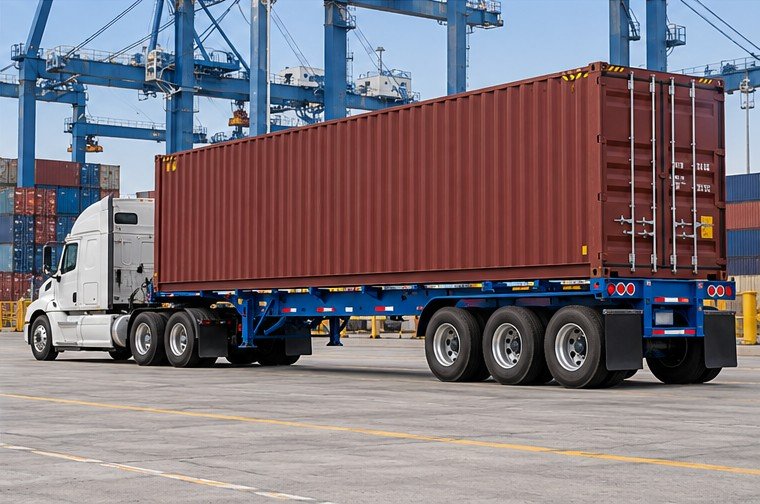
Illustration for transport planning; no customer delivery is documented here.
Selection Guide
This port-haulage scenario is a configuration example. It is not evidence of a specific delivered trailer, port contract or customer order.
Map the movement from terminal to destination
Port haulage involves crane or reach-stacker loading, gate checks and often repeated short trips. The buyer should state the container types, maximum weights, loading equipment, route distance and road rules. A skeleton frame offers access around the container, but it still needs a design for each permitted loading pattern.
Make lock positions explicit
A drawing should show all approved twist-lock positions and how each container is secured. Confirm lock accessibility, operating clearance and inspection frequency. Different container combinations may shift weight between tractor and trailer axles; ask for the design assumptions instead of relying on a generic axle count.
Check durability and service access
Review frame corrosion protection, brake and light routing, tire and suspension choice, and replacement access for frequently handled components. The final specification should include the intended tractor coupling height and the market's legal dimensions.
Define the container duty cycle
Port-to-inland work may involve frequent lifting, gate queues, short trips and repeated lock operation. State the container sizes, gross weights, number of trips, yard surface and typical road distance. The frame should be reviewed for the actual load patterns, not just its nominal length. If both 20ft and 40ft boxes are planned, the buyer needs the approved placement and lock arrangement for each; some combinations can place the kingpin and axles under very different loads.
Check terminal and tractor compatibility
Ask how the terminal transfers containers and how the trailer will be positioned under a crane or reach stacker. Review kingpin location, coupling height, rear clearance, landing gear position and turning space with the intended tractor. The frame must fit the route's legal dimensions and axle loads. A taller or lower combination can also change loading clearance. Capture these conditions in the drawing rather than assuming that any standard skeleton trailer will match the terminal process.
Design for inspection and wear
High-frequency container handling makes twist locks and their mounting points important service items. Confirm access for inspection and replacement, as well as protection for brake lines, wiring and lights. Discuss corrosion protection if the equipment works near a marine terminal. Tire and suspension choices should reflect road conditions and service availability, not merely the lowest first cost. Ask the supplier to identify which components are standard and which can be sourced locally.
Document the approved layouts
The purchase specification should include frame dimensions, lock positions, container combinations, rated components and inspection criteria. Prepare an operating checklist for lock engagement and container condition before travel. Compare a skeleton design with a flatbed if the buyer also needs to carry general freight. This is a hypothetical configuration guide; no port contract, container move or customer delivery is being claimed.
Related trailer products
Use these product pages to compare available trailer layouts with the requirements discussed above. Final dimensions, capacity and components must be confirmed against your cargo, route and local rules.
- 3 Axle Skeleton Container Trailer — Lightweight skeleton s…
- 2 Axle Skeleton Semi Trailer — 2 axle skeleton contai…
- 40ft Container Flatbed Trailer — 40ft flatbed trailer w…
Frequently asked questions
Does a skeleton trailer need a different layout for 20ft and 40ft containers?
The approved lock locations and load distribution must be checked for every intended container arrangement.
Is a two-axle skeleton trailer always cheaper to operate?
Not necessarily. The legal load, empty weight, route, tire and maintenance costs must be compared for the actual container duty cycle.