Application Overview
This hypothetical tanker selection scenario shows questions to resolve before requesting a design. It does not claim a completed fuel-delivery project or a certified specification.
Questions to Confirm
- Identify the exact liquid and its properties
- Determine volume and compartment requirements
- Review loading and discharge procedures
- Meet destination-market safety regulations
Configuration Options to Discuss
- Select tank material and lining for the liquid
- Agree compartment, baffle and outlet layout
- Specify required safety and recovery equipment
- Request applicable test and compliance documents
Planning Checklist
| Application | Liquid transport |
|---|---|
| Liquid | To be specified by buyer |
| Tank material and volume | To be confirmed |
| Certification | Depends on destination and cargo |
Application Visual
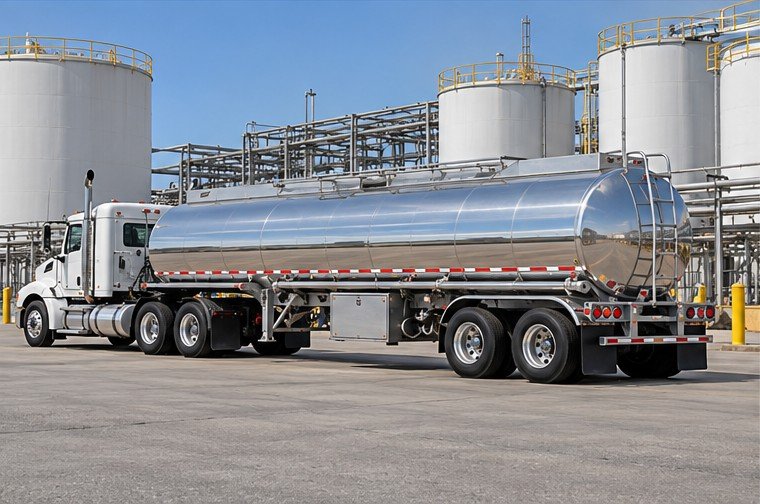
Illustration for transport planning; no customer delivery is documented here.
Selection Guide
This hypothetical tanker selection scenario shows questions to resolve before requesting a design. It does not claim a completed fuel-delivery project or a certified specification.
Liquid properties come first
The exact cargo determines compatibility, cleaning, sealing and safety requirements. Provide the liquid name, relevant safety data, density, temperature range and loading/discharge method. Avoid choosing a tanker based on nominal volume alone: weight limits and compartment fill rules can control the usable load.
Design for the operating process
Discuss compartments, baffles, manholes, valves, hoses, grounding, vapor control and emergency equipment only in the context of the cargo and local rules. The final tank material, wall thickness and test regime must be established by the engineered design and applicable approvals. Generic marketing copy cannot replace those documents.
Confirm approvals before manufacture
Identify the destination country and route, then ask for the required drawings, test certificates, component specifications and inspection plan. Confirm who is responsible for local registration and any dangerous-goods requirements before a deposit or production approval.
Identify the liquid before selecting equipment
Provide the exact product name, safety data, density, temperature range and whether different liquids will share the tank. Chemical compatibility affects tank material, seals, hoses, cleaning procedure and inspection regime. A generic label such as 'fuel tanker' is insufficient to choose those parts. The buyer should also state loading and discharge rates, site connections and whether bottom or top operations are planned. Volume is only one part of the operating requirement.
Review compartments and weight distribution
A compartment arrangement can help separate products or manage deliveries, but it also changes piping, empty weight and cleaning. Ask for a drawing of compartment capacities, baffles, manholes and outlet positions, then consider how partial loading affects axle and kingpin loads. The actual usable quantity depends on liquid density and legal operating limits. Avoid assuming the nameplate tank volume equals permitted payload on every route or with every tractor.
Specify safety equipment with the destination market
Tank transport rules differ by cargo and jurisdiction. Discuss grounding, overfill protection, vapor handling, emergency shutoff, valves, lighting, placards and required test certificates with the applicable authority or qualified adviser. A sales illustration cannot demonstrate compliance. Ask which standards the proposed design follows, who performs testing and which documents will be handed over before registration. If the buyer has a terminal-specific loading requirement, include it in the design brief before quotation.
Set the acceptance and service plan
Define pressure or leak tests, component inspection, calibration where needed, cleaning documentation and spare-parts requirements in the contract. Agree on inspection access and maintenance training for the chosen valve and piping layout. Before manufacture, approve a dimensioned drawing and a written list of materials and safety components. This example intentionally makes no claim about a real fuel order, certified tank volume or legal approval in a particular country.
Related trailer products
Use these product pages to compare available trailer layouts with the requirements discussed above. Final dimensions, capacity and components must be confirmed against your cargo, route and local rules.
- 3 Axle Fuel Tank Semi Trailer — 3 axle fuel tank semi …
- 40000L Fuel Tanker Trailer — 40000L fuel tanker tra…
Frequently asked questions
Is every fuel tanker suitable for every liquid?
No. Chemical compatibility, density, temperature, equipment and legal requirements vary by cargo and market.
Can the same tank carry diesel and another liquid?
Only after checking chemical compatibility, cleaning rules, certification and operational procedures for each cargo. Do not infer suitability from tank appearance alone.