Application Overview
This hypothetical excavator transport scenario explains how to specify a lowbed trailer. It is not a completed customer delivery, and no payload or machine model has been verified.
Questions to Confirm
- Confirm excavator operating and transport weight
- Measure track width, height and ground clearance
- Check route restrictions and loading surface
- Plan safe restraint and unloading
Configuration Options to Discuss
- Select deck length and height around the actual machine
- Review ramp width, angle and rated loading method
- Match axle and tire arrangement to legal route limits
- Request a drawing and restraint plan before production
Planning Checklist
| Application | Excavator transport |
|---|---|
| Payload | To be confirmed |
| Deck and ramp | To be confirmed by machine dimensions |
| Axles | To be selected for route and legal limits |
Application Visual
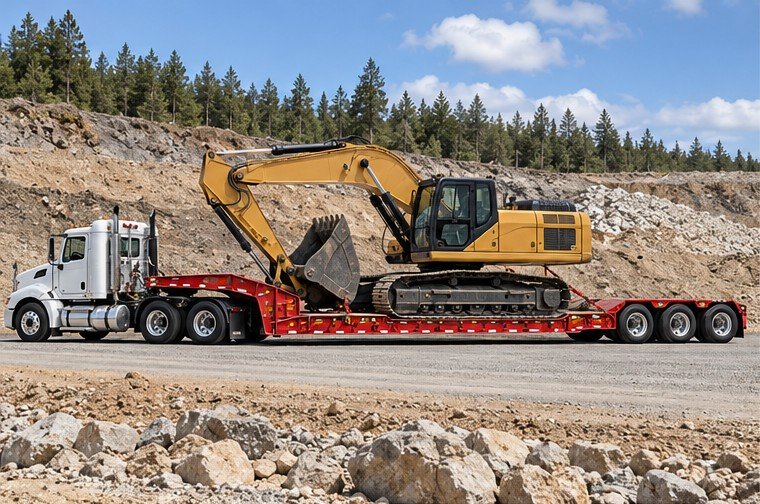
Illustration for transport planning; no customer delivery is documented here.
Selection Guide
This hypothetical excavator transport scenario explains how to specify a lowbed trailer. It is not a completed customer delivery, and no payload or machine model has been verified.
Start with the exact excavator
An excavator can differ substantially in weight and dimensions depending on bucket, boom position and attachments. The buyer should provide the transport weight, overall height, track width and loading method. The deck length must accommodate the machine and its securement points; a low deck helps with height limits, but its available ground clearance must still suit the route.
Choose ramps and axle layout together
Mechanical and hydraulic ramps create different operating and maintenance requirements. Ask for a ramp drawing that shows width, approach angle and rated loading method. Then review axle count, suspension and tires against the load distribution, road conditions and local legal limits. A nominal trailer capacity on a sales page is not sufficient to approve the combination.
Confirm the complete movement
Check loading ground stability, overhead clearance, turning space, lashing points, tractor compatibility and unloading access at destination. Before ordering, request a dimensioned drawing, component list and written operating assumptions.
Build the machine envelope
Before selecting a deck, prepare a transport drawing of the excavator in its shipping position. Include the boom and bucket arrangement, tracks, attachment weight, overall length, width and height, and the center of gravity if available. The operating weight published for a base machine may omit attachments, fuel or tools. Ask how the complete load will sit on the trailer and where it can be tied down. These facts are more useful than choosing a trailer by a broad advertised tonnage band.
Compare deck and ramp choices
A lower platform can help with overall height, but it may reduce ground clearance at slopes, speed humps and uneven worksite entries. Review the route before fixing deck height. Ramp choice depends on track geometry, loading surface, available operator space and maintenance capability. A hydraulic ramp can change the operating sequence and service needs; a mechanical ramp may be simpler but require different handling. Request the ramp angle and rating in the engineering drawing rather than assuming all lowbeds load the same excavator.
Calculate the operating combination
The tractor, kingpin, trailer axles and tires share the load. Request an engineering explanation of weight distribution for the proposed excavator position and compare it with route permits and local axle limits. Include turning radius, bridge or highway restrictions, site access and the final delivery point. A fourth axle is not automatically better than three: it may help a particular permitted load while increasing empty weight, tire wear or maneuvering constraints. The decision should be tied to the actual route and machine.
Specify securement and handover
Agree on suitable lashing points, restraints, wheel or track blocking where appropriate, and who prepares the load plan. The driver needs safe loading and unloading instructions for the chosen ramp and ground conditions. Before ordering, request the final drawing, component list, allowable loading assumptions and any required inspections. This example contains no verified machine model or payload; the buyer's data determines whether the proposed lowbed is suitable.
Related trailer products
Use these product pages to compare available trailer layouts with the requirements discussed above. Final dimensions, capacity and components must be confirmed against your cargo, route and local rules.
- 3 Axle Lowbed Semi Trailer — 3 axle low bed semi tr…
- 4 Axle Low Bed Heavy Duty Trailer — 4 axle heavy duty lowb…
- 3 Axle Extendable Lowbed Trailer — Extendable lowbed trai…
Frequently asked questions
Can one lowbed carry every excavator?
No. Machine weight, dimensions, loading method and local road rules determine whether a particular configuration is suitable.
When is an extendable lowbed relevant?
It may help when the machinery length or distribution cannot be handled by a fixed platform. Confirm the extension range, resulting legal length, load distribution and loading method for the exact machine.