
Configuration Support
Trailer Configuration Support Checklist
Use this checklist to confirm trailer type, payload, axle, suspension and tire before requesting a quotation.
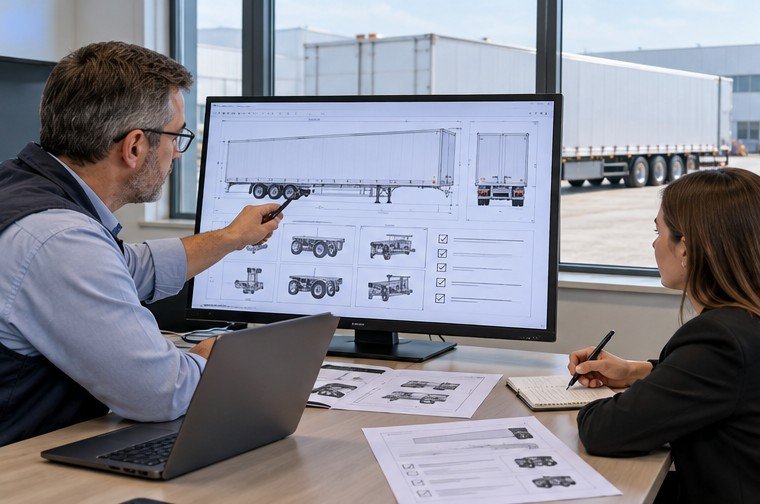
Why a Detailed Configuration Checklist Matters
When requesting a quotation for a semi-trailer, it’s essential to go beyond basic product descriptions. A detailed configuration checklist ensures that all technical and operational requirements are clearly defined—preventing costly errors, misalignments, or delivery delays. This guide outlines the key elements to include when specifying a trailer, helping buyers make informed decisions based on real-world conditions.
Cargo Type and Payload Requirements
Clearly define the type of cargo—whether it’s bulk materials, machinery, or fragile goods. This directly influences the trailer’s load capacity, floor strength, and internal design. Always specify the maximum payload, including any dynamic loads or vibrations. For example, a lowbed trailer may be better suited for heavy machinery, while a flatbed is ideal for oversized or irregularly shaped loads.
Dimensions and Route Constraints
Include exact dimensions such as length, width, height, and approach angles. These are critical for route compliance, especially when navigating narrow roads, bridges, or tunnels. A route that includes steep gradients or tight turns may require a trailer with specific axle spacing or a lower center of gravity. Always verify these constraints with local transport regulations.
Trailer Type and Axle Configuration
Choose between a 3-axle flatbed semi-trailer for general cargo or a 3-axle lowbed semi-trailer for specialized transport. Axle configuration affects weight distribution, braking efficiency, and road legality. Always confirm axle spacing and load distribution with approved technical drawings.
Suspension, Brakes, and Tires
Specify required suspension type (e.g., leaf spring or air suspension) and braking system (e.g., dual or servo-brakes). Tire type and size must match the load and terrain—such as high-pressure tires for heavy payloads or all-terrain tires for off-road routes. These components must be aligned with both safety standards and operational conditions.
Loading and Climate Considerations
Consider how cargo is loaded—manual, mechanical, or automated—and whether the trailer will be exposed to extreme weather. For instance, in cold climates, insulation or anti-freeze systems may be needed. In humid or corrosive environments, corrosion-resistant materials should be specified to extend service life.
Check the tractor and loading method
Send the supplier the tractor model, fifth-wheel height and intended loading equipment before approving the specification. A lowbed ramp arrangement, container twist-lock layout or side-wall height can change how a trailer is used even when the advertised payload looks similar. Ask for a drawing that shows these interfaces and the load positions you expect to use. If your cargo changes seasonally, describe each duty cycle separately rather than asking for one generic capacity figure.
Documentation and Acceptance Criteria
Ensure all documentation—including technical drawings, compliance certificates, and acceptance criteria—is clearly defined. Buyers should compare actual trailer drawings with generic catalogue figures, as real-world performance depends on specific configurations. Always refer to the approved drawing for final validation before placing an order.
Conclusion: A well-prepared configuration checklist reduces risk, improves efficiency, and ensures the trailer meets both operational and regulatory demands. Always validate specifications against the approved technical drawing, as payload, route, and axle configurations directly impact performance and safety.