
Factory Visit Guide
Custom Semi Trailer Technical Meeting: Questions to Ask Before Ordering
Use a technical meeting to agree on cargo, route, tractor compatibility and the configuration decisions that affect a custom trailer order.
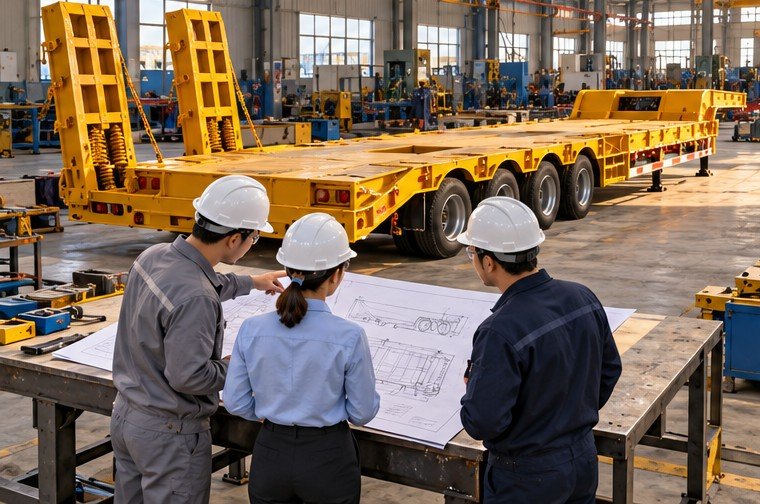
A productive technical meeting converts a broad request such as 'heavy-duty trailer' into a drawing and a verifiable component list. Buyers can use the questions below during an in-person factory visit or a remote engineering call. No customer project is being represented here.
Define the transport job
Identify what will be carried, its maximum dimensions and weight, how it will be loaded, and whether one trailer must handle several cargo types. For a lowbed, discuss machinery ground clearance and ramp approach; for a flatbed, discuss container positions and restraint points; for a tanker, discuss the exact liquid and safety rules. A single generic payload figure cannot answer these questions.
Match the tractor and route
Provide the tractor make, fifth-wheel height, coupling requirements and available power. Describe highways, site roads, gradients, climate and any restrictions on length, axle load or gross combination weight. Engineering choices such as suspension and tire specification should follow those inputs and local approval requirements.
Agree on evidence before pricing
Request a dimensioned drawing and a written list of axle, braking, tire, electrical, landing gear and surface-treatment components. Mark any item that is provisional. Discuss inspection, spare parts, shipping method and delivery terms alongside price so that quotations can be compared on an equal basis.
Use one transport brief for everyone in the room
Sales, engineering and purchasing should work from the same cargo description, drawing revision and route assumptions. Specify whether a payload figure describes the cargo alone or the trailer and cargo together. Include the heaviest unit, any concentrated load, loading equipment and unloading conditions. If more than one trailer type is being compared, write down which application each option serves. This avoids comparing a lowbed offer against a flatbed quote that solves a different problem.
Discuss the product-specific tradeoffs
A lowbed meeting should examine deck height, ground clearance, ramp operation and machinery restraint. A container flatbed discussion should focus on lock locations, permitted container combinations and axle-load distribution. A fuel tanker discussion starts with the exact liquid, tank material, compartments, discharge process and local approvals. For each option, ask which design choices raise empty weight, simplify maintenance or change shipping dimensions. The engineering answer should appear in the final drawing and price breakdown.
Make the tractor and road part of the specification
The trailer does not operate alone. Provide the tractor model, fifth-wheel height and coupling requirements, then discuss local length, axle-load and gross-weight rules. Describe the proportion of highway, unpaved road and worksite travel as well as gradients, turning radius and seasonal conditions. Where data is missing, ask for a conditional proposal with clear assumptions instead of a falsely precise capacity claim. A configuration that works in one market may need changes before registration in another.
Record approvals and commercial boundaries
End the meeting with an issue log: who confirms tire size, brake standard, paint system, component brand, test document and spare-parts package? Ask for an updated drawing, specification and quotation with the same revision number. Note what is included in inspection, packaging, inland transport and export documentation. A change after approval should be documented with its effect on price and delivery time; otherwise the meeting has not yet produced a reliable order basis.
Related trailer products
Use these product pages to compare available trailer layouts with the requirements discussed above. Final dimensions, capacity and components must be confirmed against your cargo, route and local rules.
- 3 Axle Lowbed Semi Trailer — 3 axle low bed semi tr…
- 40ft Container Flatbed Trailer — 40ft flatbed trailer w…
- 3 Axle Fuel Tank Semi Trailer — 3 axle fuel tank semi …
Frequently asked questions
What is the most useful result of a technical meeting?
A revised drawing and written specification with unresolved points assigned to an owner and date. This prevents assumptions from becoming production changes.
What if the buyer does not know the final axle count?
Provide cargo, tractor and route data first. The supplier can propose alternatives and explain their load distribution, legal limits and maintenance implications before the buyer approves one.